

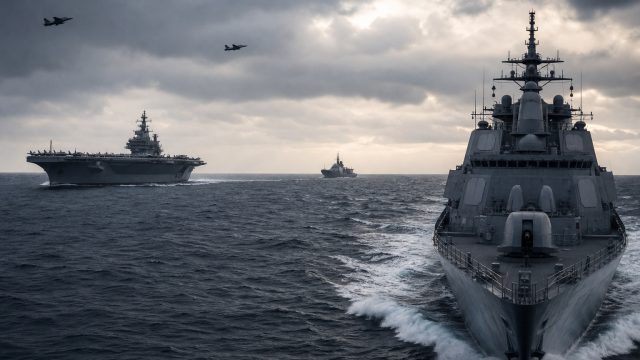
The ongoing geopolitical tug-of-war in the Taiwan Strait has seen a significant escalation recently, as the U.S. has publicly condemned China’s assertions of authority over foreign vessels navigating near Taiwan. This confrontational stance from Beijing not only raises alarms among neighboring countries but also reflects deeper implications for international maritime laws and regional security.
China's Aggressive Naval Posturing
In recent weeks, Chinese military forces have intensified their operations in the Taiwan Strait, a crucial waterway that separates Taiwan from mainland China. The People’s Liberation Army (PLA) has conducted a series of drills, coinciding with the deployment of its latest aircraft carrier, the Fujian. These maneuvers are seen not just as a show of strength but as a direct challenge to international norms governing maritime traffic.
The Impact on Maritime Trade
The Taiwan Strait is a vital passage for global trade, with millions of tons of cargo passing through it daily. China’s recent actions have raised concerns among international shipping companies and governments about the safety and legality of their operations in these waters.
- Increased risks of military confrontation.
- Potential disruptions to shipping routes.
- Heightened insurance costs for vessels transiting the region.
U.S. Allies React
The U.S. has not acted alone in its rebuke of China. Countries including the UK, France, and Germany have voiced their apprehensions about Chinese military activities. These allies emphasize the importance of maintaining freedom of navigation in international waters, a principle that underpins global trade and stability. The unity among these nations illustrates a collective stance against unilateral actions that threaten peace in the region.
Legal and Diplomatic Ramifications
China's naval claims raise pressing legal questions regarding the interpretation of international maritime law. The United Nations Convention on the Law of the Sea (UNCLOS) provides a framework for maritime navigation, and many analysts argue that China’s assertive stance may be interpreted as an infringement on the rights of other nations.
International Naval Responses
In response to China’s drills, the U.S. and its allies have increased their naval presence in the region. This includes joint military exercises aimed at showcasing their commitment to safeguarding maritime freedoms. Such operations serve multiple purposes:
- Reassuring regional allies of their security commitments.
- Sending a clear message to China about the limits of its maritime claims.
- Preparing for any contingencies that may arise from escalating tensions.
Potential for Future Conflicts
The situation remains fluid, with analysts warning that miscalculations could lead to unintended confrontations. The stakes are high: a military incident in the Taiwan Strait could have repercussions that extend far beyond the region. As the global community watches closely, the need for diplomatic dialogues becomes increasingly urgent to prevent escalation.
Conclusion: The Road Ahead
The ongoing naval standoff between the U.S. and China near Taiwan testifies to a world at a crossroads—caught between rising nationalism and the need for cooperative international relations. As both sides prepare to navigate these tumultuous waters, the actions taken in the coming weeks will be critical in shaping the future of not only Taiwan but also the broader Asia-Pacific region.
Continued vigilance and dialogue will be essential to maintain peace and security in this vital maritime corridor. The international community must remain engaged, advocating for adherence to international laws and norms to ensure that such tensions do not escalate into a larger conflict.
