

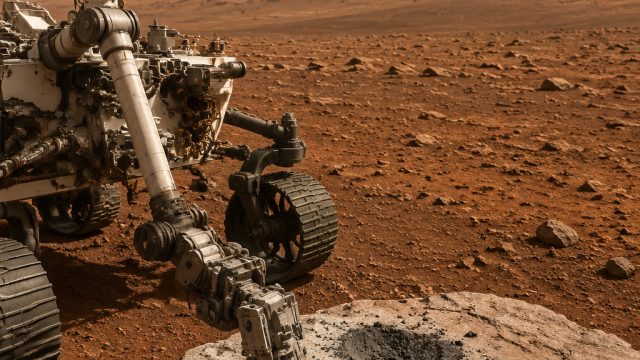
The quest to understand life beyond Earth has taken a significant turn with NASA's latest discoveries on Mars. The Perseverance rover has identified complex carbon molecules embedded in Martian rock formations. This finding has ignited discussions about the planet's potential to have harbored life in its distant past.
What Did the Perseverance Rover Discover?
Recently, the Perseverance rover, equipped with cutting-edge scientific instruments, examined an intriguing site on Mars rich with mudstone. Here, it detected organic carbon compounds that may serve as vital clues in understanding the planet's geological history and its capacity to support life.
Complex Carbon Signals a New Era in Mars Research
The discovery of complex carbon compounds is groundbreaking. These organic materials, which are essential for life as we know it, raise tantalizing questions about Mars' ancient environment. The mission team expressed excitement over these findings, emphasizing their significance in the broader search for extraterrestrial life.
- Understanding Mars' Past: The presence of organic molecules suggests that Mars may have once had conditions suitable for microbial life.
- Future Missions: Insights from the Perseverance rover will shape upcoming missions aimed at further exploring the Red Planet.
- Implications for Life: This discovery opens up discussions about the types of life that could have existed on Mars, influencing astrobiology research.
Why This Matters Now
The implications of this discovery are profound, especially in the context of the ongoing race to explore Mars. As private companies and space agencies ramp up their missions to the Red Planet, understanding its past becomes crucial. The ability to prove that life once existed—even in microbial form—could redefine humanity's approach to space exploration.
Technological Advancements in Space Exploration
The Perseverance rover utilizes state-of-the-art technology, including advanced spectrometers and cameras, enabling it to analyze Martian rocks in unprecedented detail. This level of analysis has only become feasible due to rapid advancements in technology, making the findings even more significant.
- Increased Data Collection: The rover's capabilities allow for extensive data collection, providing a wealth of information for scientists to analyze.
- Collaborative Efforts: The mission is a collaborative effort involving international experts, showcasing the global interest in Martian research.
- Public Engagement: NASA's transparent reporting of findings fosters public interest in space, encouraging future generations to pursue careers in STEM fields.
Next Steps in Mars Exploration
With the success of the Perseverance rover, the next steps include more detailed analyses of the collected samples and planning for potential human missions to Mars. The data gathered could lead to significant scientific breakthroughs and possibly pave the way for establishing human presence on the planet.
Building on Recent Discoveries
As we build on these discoveries, NASA scientists and their partners are considering the implications of this carbon discovery. Understanding how and why these compounds formed could provide insights into the history of water on Mars, a critical factor in determining the planet's capacity to support life.
Conclusion
The Perseverance rover's recent findings of complex carbon on Mars mark a pivotal moment in the ongoing exploration of the planet. As scientists delve deeper into the implications of this discovery, it reaffirms Mars' potential as a significant player in the search for extraterrestrial life. With future missions on the horizon, this is an exciting time for space enthusiasts and researchers alike.
