

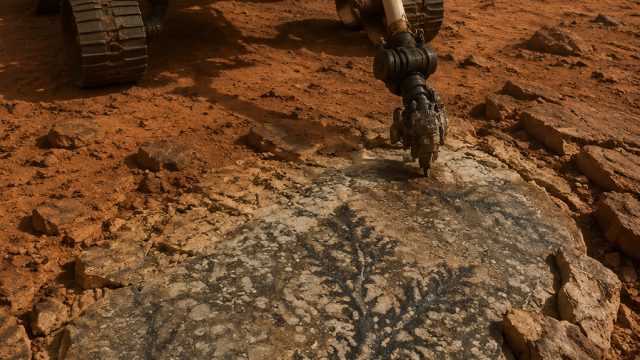
NASA's Perseverance rover has made a groundbreaking discovery on Mars, unveiling complex carbon molecules that may hint at the existence of ancient microbial life. This revelation not only fuels scientific curiosity but also opens new avenues for understanding our celestial neighbor's past. As we dive into this significant finding, the implications for future Mars exploration and our quest for extraterrestrial life become increasingly important.
The Discovery: Complex Carbon Molecules in Mars’ Mudstone
At the heart of this discovery is the identification of organic carbon, which was found embedded within mudstone at a location known as Jezero Crater. This crater, believed to be an ancient lake bed, presents a promising site for past biological activity. Researchers are particularly excited because organic carbon is a fundamental building block of life as we know it.
What Are Organic Molecules?
Organic molecules are carbon-containing compounds that play essential roles in living organisms. They are not only the foundation for life on Earth but also serve as potential indicators of life elsewhere in the universe. The detection of these molecules on Mars is a significant step forward in the search for life beyond our planet.
Why This Matters Now
This discovery comes at a pivotal time as scientists are intensifying their efforts to explore Mars and its potential to host life. The Perseverance rover's findings coincide with the planned launch of the ExoMars mission, which aims to search for signs of life in greater detail. Understanding the nature of these organic compounds may help us decipher whether they originated from biological processes or non-biological reactions.
Implications for Future Mars Missions
- ExoMars Mission: The upcoming ExoMars mission will analyze the chirality of these organic molecules, which can indicate biological origins.
- Sample Return Missions: Future missions may focus on returning samples from Mars to Earth for thorough laboratory analysis.
- Broader Search for Life: Insights gained from Mars could inform our search for life on other celestial bodies, including moons of Jupiter and Saturn.
Global Interest and Collaboration in Space Exploration
The findings from the Perseverance rover have sparked global interest and collaboration across various space agencies. As countries intensify their exploration efforts, understanding Mars' geological history and potential for life could lay the groundwork for future human missions to the Red Planet. The scientific community continues to emphasize the need for international cooperation in space exploration, showcasing a shared human desire to understand our universe.
Public Engagement and Education
As discoveries like this capture the public's imagination, there is a growing emphasis on engaging educational initiatives. Schools, universities, and science organizations are harnessing this excitement to promote STEM education, encouraging the next generation of scientists and explorers.
Conclusion: A New Era of Mars Exploration
The detection of complex carbon molecules by NASA’s Perseverance rover marks a transformative moment in the quest for understanding Mars. This finding not only sheds light on the planet’s past but also propels humanity closer to answering one of our most profound questions: Are we alone in the universe? As we advance our exploration efforts, the excitement surrounding Mars continues to grow, inspiring future missions that could ultimately reveal the secrets of life on other planets.
